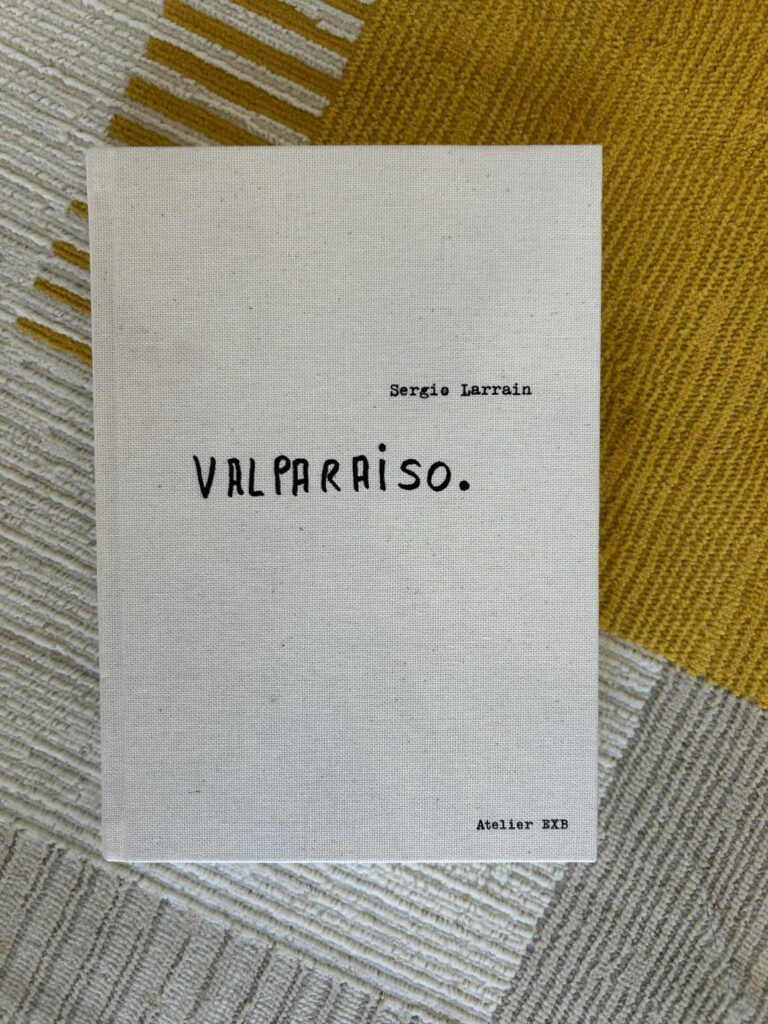
There are photography books that transcend the mere shelves of photographic history to become inner maps. Sergio Larraín ’s *Valparaíso* is one of them. First published in 1991 and reprinted many times, it is now considered not only a classic but an implicit guide to how to look at the world. A book that every student at a photography school should encounter, in Rome as in any part of the world.
Sergio Larraín (1931–2012) was a unique figure. A Chilean who grew up in affluent circumstances, he chose early on to distance himself from institutional circles. He collaborated with Magnum Photos in the 1960s, creating iconic images in London and the Middle East. But his professional career was short-lived: at the height of his international recognition, he decided to retire, live in solitude, and devote himself to meditation and writing.
This radical detachment, which to many sounds like a renunciation, has made his work even more legendary: few publications, a limited body of work, and the aura of a photographer-philosopher, almost invisible.
The book *Valparaíso* brings together the work Larraín created in various phases between the late 1950s and the 1960s in this Chilean port city, nestled between the sea and the hills. It is not a traditional photo essay; rather, it is a lyrical journey.
The photographs show narrow alleys, staircases winding like snakes, children playing with water, lovers embracing on terraces. In every image there is a sense of movement, of a fragment captured at the very edge, as if the photographer were always one step behind, discreet, almost a passerby watching without being seen.
Photography as a spiritual practice
Reading *Valparaíso*, one senses that for Larraín, photography was not merely a profession but an inner journey. The diagonal composition, the use of light and shadow, and the constant play of reflections seem to teach us that the gaze must be trained to seek meaning between the visible and the invisible.
It is a highly relevant lesson for those studying photography today: learning to step back, to leave room for life rather than dominating it with the lens.
In the digital world, where every image is consumed at the speed of a thumb swiping across a screen, returning to a photographer like Sergio Larraín means rethinking the value of slowness.
In Rome, where photography schools coexist with Europe’s most powerful iconographic tradition, Valparaíso offers a valuable tool: not a technical manual, but an ethical and aesthetic compass. Teaching young photographers to look beyond the subject, to find the rhythm of the streets and faces, is perhaps the best way to cultivate a contemporary gaze.
Studying Sergio Larraín is not an act of nostalgia, but an exercise in freedom. *Valparaíso* remains an essential book of photography, because it reminds us that the true image is never the one that reveals everything, but the one that leaves room for mystery.
Discover our photography courses.