It is January 6, 1979, and photographer Anton Corbijn is taking pictures of a little-known band from Manchester at the Lancaster Gate subway station, not far fromNottingHill. The band was known in the north of England as Warsaw, a name they would soon have to change, as it had already been claimed by another local punk band.Theywould becomeJoyDivision: a cheerful, jovial, carefree name, one might think. Not exactly: Joy Divisions were groups of women, mostly ofJewishorigin or political prisoners, forced into sexual slavery in Nazi concentration camps. Not that the band had any neo-Nazi sympathies—quite the opposite: it was simply one of the trendy gimmicks of the punk era, much like the swastika on Sid Vicious’s T-shirt—a guy who barely knew what Nazism was—the aim was to cause a scandal, to cause a scandal in the ’70s.
In this image, which has since become iconic, we see the four band members looking straight ahead, toward the stairs that still lead down to the subway platform today. We’re in West London, the cold is biting, and the fourth from the right is Ian, who dreams of becoming a singer. He’s posing in a long coat, his gaze lost in space, distant, his hair flattened; he looks more like the boy next door than a rock star. In fact, on that January 6, 1979, he was still working as a clerk at the Job Center in Macclesfield,near Manchester.
Perhaps Ian Curtis already knew that, starting with that famous photo taken on the stairs of the London Underground, he would kick off a meteoric era of words and music, paving the way for a new genre: post-punk. Dark-toned songs that have become legendary, such as “Love Will Tear Us Apart,” “Atmosphere,” “Transmission,” “She’s Lost Control,” “Decades,” and “Dead Souls”—a musical output concentrated into just two albums, one of which was released posthumously.
“Here come the young men, with the weight on their shoulders, Here come the young men—well, I’ve seen them before, We knocked on the doors of Hell’s darkest chamber, Driven to the limit, we dragged ourselves inside” — (from Decades)
This son of the working-class, gray Manchester of the 1960s and 1970s is a poet; he is a vampire, a supernova, a trail of light etched into the darkness of space, a pulsar: just like the iconic image of the 80 consecutive radio pulses emitted by pulsar CP 1919 on the cover of the album that catapulted them to global fame: Unknown Pleasures.
According to the horizontal dimension of time—Chronos—that iconic snapshot is part of a segment now complete, a faded postcard of a bygone era; the images, words, and music, however, manage to detach themselves from space-time by rising vertically: no longer the human being and the rules that govern him, but the universal projection of his thought without interruption, in a verticality that makes us all, inexorably, contemporaries.
Head down the stairs at Lancaster Gate, hop on the CentralLine, and after about twenty minutes you’ll arrive at King’s Cross, the heart of the London Underground—a labyrinth of staircases brimming with stories, languages, flavors, and meaning.
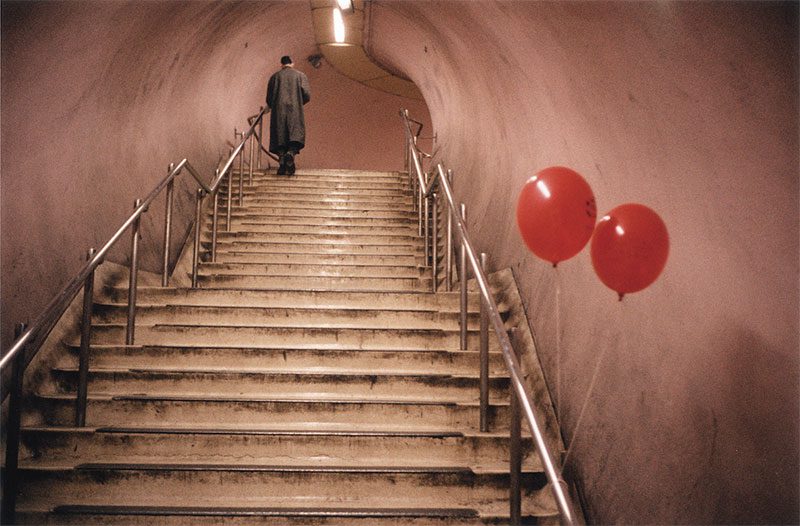
“London, Tokyo, New York: cities change, but the smell of burnt iron and the alienation on the faces beneath the neon lights remain the same,” writes Marco Pesaresi in describing his work on 10 subways around the world, which will become his book: *Underground*. Deep within the earth, the Rimini-based photographer immerses himself in the metal and claustrophobic spaces of the underground, offering us a glimpse rich in emotion, transforming a non-place par excellence into the center of the world.
Hours, months, days—these are the units of time that pass during his personal “journey to the center of the earth.” But while Verne filled the depths of the earth with prehistoric creatures and futuristic technologies, Pesaresi, on the other hand, populates his abysses with urban “creatures”: commuters, outcasts, lovers, and drifters. Thus, we do not see the heroic, positivist man of the nineteenth century, but the human being—alienated and fragile, unfiltered because immersed in his own daily life.
“Underground is a coming-of-age story in which color photography serves as a mediator between the author’s explosion of conflicting emotions and the need to be a witness rather than a protagonist—a choice that is always difficult for a photographer—who shares with us his love for photography, caught in a constant struggle between being and appearing.”
Milan, Paris, London, Berlin, Madrid, Moscow, New York, Mexico City, Kolkata, and Tokyo become a personal human atlas in which to lose oneself and escape the weight of the surface, amid subway cars and staircases leading to suspended times and places, with one ultimate goal: to give meaning to one’s journey.
Don't miss the YouTube video: